Showing posts with label medicine. Show all posts

January 2, 2019

... And Then There Were Three

January 02, 2019 1
“There’s no perfect time.” I spent hours researching when to have a child in medical school and that phrase was used in almost every website and blog post I stumbled upon. I always knew that I wanted to have at least one child whole in med school (maybe even two!) but I couldn’t figure out when. And “there’s no perfect time” was no help. The best advice I received came from one of our deans. She said,

“The longer you wait, the more important you become.”


Taking time off as a medical student will not impact the hospital in any significant way. But when you become a doctor, and when you start climbing up the ladder of positions, the hospital may not be able to afford your absence. So even though the internet says there was no perfect time to have a child, the dean made me realize that there might be a best time to have a child.

We found the best time for us. The time between my second and third year of medical school, my MPH year. I expect that next year will be the hardest year of med school. I will have some intense shifts with crazy hours and no break longer than two weeks. It would be impossible to get pregnant that year without having to take time off (maybe even an entire year off) from med school. So once I found out I got accepted into the dual MD/MPH degree program, my husband and I found this elusive “perfect time” that I thought didn’t exist. We immediately began to look for houses, accepting the fact that though our tiny two-bedroom apartment was the best place for us at the time, it wasn’t where we wanted to raise a family. I removed my IUD and as we house shopped, we did the baby dance (hehe). In order to give birth and have some time off as a new mother before my hardest year of medical school, we had to get pregnant before September. My mind tends to imagine the worst whenever I truly long for something, so of course I was scared I was infertile when I didn’t get pregnant the first few weeks. My fears were quickly relieved though when I missed my next period. I got my first positive pregnancy test less than a month after moving into our new house. Mid-September, perfect timing (for us. Everyone’s “best time” will be different. My medical school journey will not be practical, ideal, or even desirable to everyone).

Yes, we’re scared. We don’t know where life will take us. I know that things don’t always work out as planned and you have to find a way to navigate the surprise speed bumps life lays on your path. Neither of us has experience with babies. My husband is the youngest and I was still a child when the youngest people in my family were born. I’ve never even seen a dirty diaper, much less changed one. We will be learning as we go, adapting to life’s twist and turns and hoping for the best. But we aren’t the first to embark on this journey. It’s been done before and it will be done again. Doctors have children. Female doctors have children. In every step of their medical career, regardless of their year in med school or in residency. So our excitement definitely outshines our fear! And I’m excited to keep you all updated about how I juggle my family and my medical career.


I hope you all had a wonderful holiday season and a happy New Year!

P.S. We recently had a gender reveal party. Click here if you want to check it out!

August 23, 2018

One Degree Hotter

August 23, 2018 0

As a doctor, I will be saving lives. Individual lives. But what if I want to affect an entire population? What if saving a single life isn’t enough? I’ve taken a break from the hospital this year to pursue a Masters in Public Health. As a self-proclaimed social justice warrior (I know that label might have a negative connotation but I wear it proudly) and a lover of all things medicine, the decision to get a Masters in Public Health was a no-brainer. It’s frustrating how undervalued the field of Public Health is. Curative medicine is more attractive to the public than preventative medicine is. And in our individualistic (“it’s their problem, not mine”) society, people don’t realize (or choose to not realize) how much the health of their society affects them. But those in public health still find ways to change the world. It’s a thankless, but meaningful, field of medicine. I love everything I'm learning so far. My classes are addressing the problems I always talk about. But now I'm learning how to actually do something about them. So many things about our healthcare system need to be improved and I'm learning how to make a real impact. Even our first required project will transform a community (I'll write more about that later). I'm excited for what this year will bring.

After this year, I will return to the hospital with the rest of my med school classmates and graduate as a doctor with a Masters.

I have another reason for getting this second degree. All around me, I’ve seen classmates either burn out or get close to burning out. You know something they don’t tell you before you start med school? We have the highest number of suicides than any other grad school program. That includes law schools, pharmacy schools, nursing schools, and others. But it isn’t because of the coursework. We have an unspoken culture in medicine that makes us believe that asking for help is a weakness. We lose sleep, stop eating, and simply forget how to relax when we pour our hearts and souls into this field we love so much. And when we start to feel overwhelmed, instead of getting help, we look around and realize everyone else seems to have everything together.

If they can do it, I can do it.
I don't need a support team.
I don't want to be that one person who's struggling.

(Some people in my support team ^^ There's nothing wrong with asking for help)

So we, like the rest of our classmates, pretend we have it all together as well, unknowingly contributing to the problem. Instead of finding help, we continue to push ourselves even more. There is so much we have to do outside of school work. Honestly, almost every extracurricular thing is very fun and interesting to me and most other students. It's the balance we don't understand. Because everything is so interesting we give our all to every activity. Some of us forget to step back and breath. Not only is burn out a problem for students and doctors, it’s a problem for the patients. When doctors are out of it, people can die. It is dangerous to let doctors spiral into insanity. You don't want to put your life in the hands of an unstable physician. This is a culture my school, and many other schools, are trying to change.

I want to be an emergency room doctor

Did you know that emergency physicians have the highest rate of burnout than any other specialty? It doesn't have to be this way. I love the emergency department. I love the adrenaline, the blood and guts, the life or death situations. It excites me. I can't imagine doing anything else with my life. This means that I'll hold more lives in my hands than my peers in other specialties. So I need to make sure that I'm mentally fit to do that. This year I'll get to refresh my mind and learn how to impact the community. Through my MD program, I'll learn how to impact individuals. I'll be able to influence change through all layers of society. 


Thus begins my MPH year.


August 16, 2018

Don't Kill The Patients

August 16, 2018 0

Some of you may already know this story, but I want to share it again. A few months ago, as I held a bloody heart in my hand, I lost my first patient. She was a Jane Doe, a jumper barely alive when she was brought in. She lost her pulse seconds after she was transferred to the hospital bed. I was surprised by how quick the whole team responded. As some doctors yelled for blood and another pushed epi, a couple of them immediately made a large cut to open almost the entire left side of her chest. They used a tool to push her flesh and ribs apart and took the heart right out of the cavity. One doctor handed me the woman's heart and told me to start pumping. I literally had her naked heart between my hands as I rhythmically squeezed. I blocked out the commotion and focused on my job. I only took my hands off when the doctors shocked her with something that looked like a salad tong, then I got right back to it. I could hear them in the background yelling for blood and working on keeping her alive. A few minutes later, as my hands still held her heart and pumped, they called her time of death. They were frustrated but used this experience to teach the residents. They asked, "What could we have done better?" At the very end, they showed me how to sew her up and I closed her. And naturally, I couldn't help but wonder if I killed her. "Do no harm." That's what we're taught. What if I had broken the fundamental rule doctors are supposed to follow? I had to convince myself that her death wasn't my fault. Unfortunately as a doctor, I'll have to experience these things. But the lives saved more than make up for it. Like the patient I had a while later, a man who came in with a head laceration that he got while trying to protect a stranger. Someone shaved and numbed his very bloody head and I helped staple his scalp back together. I got him warm blankets and stayed to talk to him. He told me I did a great job and right before I left that night, he prayed for me. I would have never guessed it, but he had a greater impact on my outlook of life than the first patient did.


August 30, 2016

The Beginning

August 30, 2016 1

I feel like I've been thrown into a tornado. But I like it. My life was so calm before June but it was starting to get boring. A lot has happened and is currently happening and I feel like I'm reaching all over the place trying to find a way to stabilize myself. Side note: if you're one of my YouTube subscribers, now you know why we've been MIA haha. Anyway, right after Thailand, as if to mark the next chapter in our lives, Will cut his long golden locks in favor of a more professional short haircut. Then we moved into our current apartment. I hadn't thought of this before but I when I stepped into our new place, I realized that this was a big step in my relationship. Yes, I lived with Will for years before this but it was in a co-op, in an old frat house, with like 20 other college students/recent graduates. No we have a two bedroom, two bath, two walk-in closet to ourselves.


But even though this is a huge change for me, the biggest change came when class started. Someone told me that medical school is like trying to drink water from a fire hydrant. They couldn't be more correct. It's not like the information is incredibly difficult. It's just the amount that's thrown at us. We're expected to learn so much in a very small amount of time. On top of that, since school is just starting, there are a lot of random things I have to keep track of that sometimes take me by surprise. Buying scrubs, getting a stethoscope, livescan, mask fitting, white coat, frenzied schedule, hospital ID, gloves for anatomy, downloading the software we use to take tests, etc. And I have to admit, sometimes I longingly looked back to the boring life I had just a few months ago, but then I experience things that remind me of how much I want to be here. I dissected my "first patient" and for the first time, saw the inside of a human body. I watched an open-heart surgery on a 6 month old baby as surgeons showed me the little holes in his heart that they had to cover up. I watched them wire his tiny ribs back together and I never thought I would think a baby could be so durable. It was awe-inspiring. I saw another patient today who had a huge gash in her arm from wrist to elbow but I ended up learning more about her hectic home life and saw how resilient she was to confidently navigate through situations that many would consider traumatic. Coming home to study has more meaning to me than it ever did as an undergrad. For the first time, I can really see what I'm working towards and learning, to me, has become a blessing rather than a burden. This tornado of a life is tossing me around right now but I'm starting to go with the flow and watch the pieces fall into place. Soon it'll calm down. And I'll be flying.


January 29, 2016

Getting into med school 5

January 29, 2016 0


Requesting Letters of Recommendation
  • I think one of the most important things to do when requesting letters of recommendation is to ask your writers early!
  • Most schools require a letter from two science professors and one non-science professor. Of course sending in other letters is recommended (especially if the writer played a big role in one of the most meaningful activities you wrote about). But make sure you get the required professors to write letters.
  • I would suggest going to office hours and getting to know the professor so that they can write a good and personal letter on your behalf. Getting an A in the class is not enough because a short/bad letter is much worse than not having a letter at all. Some students go to their TA's office hours if their classes have like 200+ students. The TA can write a big part of the letter on your behalf and give it to the professor to finish and submit.
  • I also suggest talking to your writer in person and then emailing them after they agree to write the letter. They will most likely ask for a CV and and a statement of purpose (or a rough draft of your personal statement). In the email, you can give them all the details about how to submit or mail the letter to AMCAS. Make sure your email is polite and professional and send it as soon as possible.

Interviews
  • Attire: professional, no exceptions. A suit with a shirt and tie for men and a suit with pants or a skirt (with pantyhose) for women. Make sure the skirt isn't too short or too tight. When buying suits, I'd stick to black, grey, or navy blue. Shirts should always be tucked in. A lot of websites say that women should wear heels. I disagree. You'll take a tour of the school before or after every interview so make sure you wear comfortable close toe shoes. If you're comfortable in short heels, feel free to wear them. To my first interview, I wore short heels and brought flats in my bag. After that, I just wore flats to interviews. Many other girls did too. Your jewelry should be limited to small stud earrings (and maybe a necklace if it's understated).
  • Your hair should be neat and out of your face. I wore my hair in a top bun to every interview. Don't overdo your makeup. You can wear mascara/eyeliner and a little foundation if you want. But don't wear falsies or bright lipstick or anything distracting. If you absolutely have to wear makeup, go for a neutral look. Also, your nails should be clean and trimmed. I suggest not wearing any colored nail polish but if you do, make sure it isn't chipped and the color isn't too "loud".
  • Bringing a bag is optional but I recommend it. I brought a dark maroon bag that was professional looking. They will give you folders and papers so you'll need a place to put them. I also suggest bringing a portfolio folder to take notes. I saw that some websites recommended bringing a copy of your application and CV. You can if you want, but I see no point in doing so. They have all your information already.
  • Look up the school and its values before the interview. They will want to know why you applied to that specific program.
  • Some schools ask about current events in medicine so read up on that.
  • If you're flying to an interview, book your flights early and if possible, fly in two days before the interview. Especially if you're interviewing in the winter (because flights often get delayed/changed/canceled because of snow or other weather problems).
  • Be on time!!
  • Have a general idea of what you want to say but don't rehearse it. The one question you have to, HAVE TO know the answer to is, "Why do you want to be a doctor?" To help people is not a good answer. Briefly talk them through your journey to realizing medicine was for you. Know the answers to questions about your 15 activities, personal statement, and grades (some might ask why you got a low grade in a certain class).
  • Have good questions to ask at the end of the interview. Sometimes they ask if you have any questions for them. Make sure you look up the school. You can ask about specific programs or their experiences, etc. I was genuinely curious about the answers to all the questions I asked and I think they could tell. I didn't just look up what to say. And not every question was medicine-related.
  • MMIs:
    • Not every school has them but most of the interviews I had were MMI style
    • This website explains what they are is perfectly. To sum it all up, there will be different rooms ("stations") and you and your fellow interviewees will rotate through the stations. You'll have 8-10 minutes in each station and each will be very different. You might meet an actor and have to play a role (so they can see how you'd react in a certain situation), you might just be interviewed regularly, you might be given a scenario, you might have to write an essay, you might be in there with another interviewee, etc.
    • This YouTube page helped me prepare for the scenarios I faced. I really suggest watching the MMI videos. They were sooooooo helpful!
  • Get a good night's sleep the night before. Try to relax (I know it's sometimes easier said than done). Be friendly and fun to talk to.
  • My experiences:
    • I was fortunate to have an extremely relaxed first interview. It was not at all stressful. I was nervous when I arrived (the school is in LA and it rained! I thought that was a bad sign since it never rains over here). But the dean of the school was so nice and welcoming! She told us to relax and she sat down to informally chat with us. I could almost physically feel the tension leave the room after just ten minutes of talking to her. By the time she left the room, we were all joking and laughing and having a good time. My interviewer, unlike the rest, was dressed pretty casually. We went into a room with couches and a coffee table. The first question she asked was, "Tell me about yourself." And from there, our "interview" just turned into a fun conversation. Seriously, it was like we were old friends catching up. We were laughing and talking and I was getting to know her just as much as she was getting to know me. I don't think it was supposed to be like that but the way I answered the first question led our conversation away from the formal interview and towards the casual conversation. Then we were given a tour and I sat in on a class. After that, I had a student interview. The student had a list of questions to ask so our interview still felt a bit like an interview (but only a bit). She was about my age, went to my undergraduate college, and had the same major I did. We couldn't finish all the questions because of our conversations. Our interview actually ended a little late because we were still talking and we continued our conversation even as we exited the room and went back upstairs to meet the others. I genuinely enjoyed my time there. If it had been under different circumstances, I think we could have even become friends. The dean actually told us the date she would send out the acceptance/rejection emails so on that day, I was had my gmail app open on my phone basically refreshed it every 5 minutes until I got my acceptance email (I felt like crying and had to show my boyfriend to make sure I wasn't making it up in my mind). This is my #1 school (tied with another school).
    • The rest of my interviews were MMI style. Honestly, I'm not a huge fan but I think that's just because my first interview was so well. MMIs weren't that bad and those interviews seemed to go by very quickly because of the way they were broken down. I was surprised I never got the same question twice with how many schools I went to with this kind of interview style. So be prepared for anything because they have a wide variety of station questions/tasks. I got accepted into one of them (my backup school) and waitlisted at another (my #4 choice). I'm waiting to hear back from the rest.
    • Afterwards I got denied from two schools (I wasn't even invited for an interview), withdrew my application from other schools, and canceled the rest of the interviews I had scheduled.

Waiting
  • Honestly I think this is the hardest part :(
  • After the interview, send thank you notes or emails to your interviewers.
  • If the school allows it, send updates if you've accomplished more after you were interviews (new publications, new volunteer experiences, etc.)
Accepted!
  • First and foremost, CONGRATULATIONS!
  • You can hold multiple acceptances for a while. But then, some time in April, you have to choose one school. If you get accepted into another school after choosing one, you can drop the acceptance you held before and choose the new school or stick with your choice and deny a spot in the new school.
  • Withdrawing applications: I withdrew a lot  applications after being accepted into my #1 (tie with another school) choice and interviewing for my (other) #1 and #3 choices. I think it's important to withdraw your application so that you can allow other students to be interviewed/accepted in your place. There's no point taking up a spot you don't want. Thank schools the schools for not denying you, requesting an interview, or accepting you. Then politely decline their offer.

I think this will be the last part of my Getting Into Med School series. I tried to cover the topics not covered in the other posts. But let me know if I missed something! If you have any questions or comments, please don’t hesitate to leave them in the comment section below. Or you can email me directly using the “contact me” section at the bottom of my blog :)

December 10, 2015

Getting Into Med School 4

December 10, 2015 6


The personal statement is arguably the most important part of your med school application (depending on who you ask). You have 5300 characters max to explain why you want to go to med school (this is usually about a page and a half long). There are so many paths to take when writing your personal statement so how you write is completely up to you. This website has a few examples of the directions people go with their personal statement. I highly suggest you check it out if you're not sure how to start. I'm going to give some general tips about what to incorporate in your personal statement and then I'll tell you how I wrote mine.

Personal Statement Tips

  • PROOFREAD! You should type your personal statement into Word or something with spell check before submitting it to AMCAS. But mistakes include more the misspelled words. For example, if you write about a patient you met and you used a fake name (to maintain their privacy), make sure you use that same name throughout the entire essay. Also check for grammatical errors.
    • Have as many people possible look over your statement. They're probably going to catch things that you didn't.
    • The essay can't be changed after you submit it so make sure it's perfect.
  • Make sure it's not just a narrative form of your resume ("I want to be a doctor because I shadowed... then I volunteered... In 1995, I worked...").
  • Keep it relevant. If you want to mention how Dr. So-and-so had a great impact on your decision to become a doctor, that's fine. But don't spend two or three paragraphs talking about his achievements. Keep the essay about you.
  • Be unique. It's likely that you and many other applicants will have similar experiences. Think hard and ask other people. What can you say about yourself that no one else can? Yes, you'll have some things in common with other applicants, but you're still different and there are things about you that make you special.
  • Don't get fancy with your writing. No writing in all CAPS or only lower-case letters. Don't write a poem either.
  • Don't lie about (or exaggerate) your life and do not plagiarize someone else's work.
  • Avoid controversial topics. You could risk alienating someone who does not agree with you.
  • Think ahead. You might be asked to explain details during an interview so make sure you feel strongly about what you wrote.
  • Include specific experiences and how they impacted you
  • Things to consider including
    • Significant hardships or obstacles that might have affected your education
    • Explain bad grades if they aren't explained elsewhere in your application - don't apologize or give excuses though. Talk about what you learned from it and how you improved.
      • Note: when it comes to bad grades, it's important to have an upward trend. It looks really bad to explain what you learned from your bad grade but show no improvement in your transcript. That tells the committee that you didn't actually learn anything.
  • Questions to consider
    • Who are you?
    • Why do you want to be a doctor? TO HELP PEOPLE IS NOT A GOOD ANSWER. Not by itself anyway. Most professions allow you to help people in one way or another so that doesn't explain why you want to be a doctor. Be specific. What happened in your life that made you realize medicine is your passion? What helped develop your interest afterwards? 
    • What do you want medical schools to know about you that hasn't been disclosed in another part of the application?
    • How do your experiences prove that you have the characteristics you say you have?
  • Keep in mind that the readers are not medical specialists.
My Personal Statement

My personal statement was kind of like a story (with a tone similar to this one, but with a very different delivery). I tried to draw the reader in with my first sentence, a short, interesting description of the scene (the hospital). Then I gave some background information (how I got to that place in my life) and introduced the conflict (it was huge!). This kept the reader interested. I then went further back, describing my journey to how I realized I wanted to be a doctor and I described experiences that reinforced that realization. Most of my essay described my time in college. I didn't just write about what I did in general (like when you input your 15 activities), I wrote about specific experiences while I was doing those activities. For example, instead of saying something like, "I volunteered at health fairs." I would say something like, "While volunteering at ____ Health Fair, I was exposed to ___ and learned___" (not that simply written but you get the point). I described the most meaningful experiences that not only geared me towards medicine, but also discouraged me from pursuing a Ph.D (the path I was taking when I first started college). I wrote about obstacles I faced and how I overcame them (I heard that it was bad to write about obstacles/challenges if you never overcame them) and how they helped shape my character. I also made sure to include what I want to do with my MD degree (where I want to work and how I would impact my community). Throughout the body of the essay, I kept connecting what I was writing to the story I started. Though I wrote a lot, I had one overarching story and I made sure that was clear.
I ended my essay back at the original scene and described how my previously mentioned life experiences affected what happened there. I revealed the larger underlying internal conflict and how I was able to solve it while at the same time concluding the story I began.

  • I hope that makes sense. It's hard to describe my essay without being specific. But I hope that helped :)
  • By the way, it took like 10 drafts (probably more) to perfect my personal statement. I recently read over my first draft. It was horrible! So start early.

If you have any questions or comments, please don’t hesitate to leave them in the comment section below. Or you can email me directly using the “contact me” section at the bottom of my blog. Stick around for more tips and information about what to do after completing your primary application.

November 19, 2015

Getting Into Med School 3

November 19, 2015 0


When requesting letters of recommendation, it's important to bring a copy of your CV and Personal Statement when you meet up with the letter writer (or attach it to the email if you don't). If you're like me, you won't have your personal statement (or maybe even your CV) finished by the time you ask for a letter. That's ok as long as you give them a draft. They need something to work with.

CV Essentials

A CV (or curriculum vitae) is a summary of your experience, skills, and education. It's very similar to a resume but is more detailed (a description of what you did rather than just your position title) and includes more sections. I used one of the resume templates on Word to make my CV and mine was 3 pages long. It should include (if applicable):
  • Research and publications (and posters and abstracts)
    • Name of institution
    • Mentor (full name and degree)
    • Name of project and brief description
  • Honors and Awards
  • Academic Experience (not coursework)
  • Clinical experience
  • Volunteer experience
  • Professional experience
  • Certifications
  • Eduction (any place after high school from which you earned a degree)
What not to include
  • High school GPA/high school activities (unless you continued them in college)
What's nice about this is that you can use your CV when putting in your 15 activities in the AMCAS app.
You must be aware of verb tenses. If you're still doing it, use present tense. If you did it in the past, use past tense. This may seem simple but it's fairly common for people to write everything in past tense. Also, try to switch up the verbs you use. Instead of "I helped... I helped..." try "I helped... I assisted..." Feel free to use a thesaurus, but be careful. Sometimes people use random synonyms that don't make sense in the sentence.
It is important to be consistent with the format. Here's how my CV was organized:
  • Personal and Contact Information
    • Name
    • Address
    • Phone Number
    • Email
  • Professional Experience - three things
  • Research Experience - one thing
  • Academic Experience - five things
    • I included my study abroad experience and talked about how I gained cultural insight along with learning from the school.
    • DO NOT put courses here. I put academic programs in which I was involved (for example, a two year program geared towards promoting academic excellence in engineering science and a summer research program)
  • Volunteer Experience - six things
    • I put my shadowing under here
    • Three things were medical related
  • Leadership Experience - five things
  • Training and Certification - EMT and CPR
  • Career Goals
    • This is optional. Some versions of my CV don't have this section.
    • A few sentences about what I want to be (a physician) and what led me to this decision. I also included what I plan to do with my degree.
    • It was a very small section.
  • Education
    • My Bachelor's Degree (and major), where I got it, and when I got it. If you haven't graduated yet, put the date you expect to graduate and then put "(expected)"
  • Skills
    • Technical (computer skills)
    • General (important qualities and skills)
Everything was in chronological order under each category (starting with oldest and ending with the most recent). I ordered them by the date I began. So for example, April 2014-May 2015 would come before June 2014-January 2105 (even though the latter ended earlier).
My advisor told me about the "5 minute rule" which is if you can't talk about it for 5 minutes or know the names of the people involved, don't include it. Include things in which you were actively involved. Remember: quality over quantity. Most of the things I included in my CV were activities that lasted months or years.

Other CV Tips:

  • Don't get fancy with your font selection. Stick to Times New Roman or Arial, etc.
  • There's no formula for what you CV should look like but you should still look up and compare examples to make sure you're on the right track. You can click here to see some samples.
If you have any questions or comments, please don't hesitate to leave them in the comment section below. Or you can email me directly using the "contact me" section at the bottom of my blog. Stick around for more tips and information! :)

November 6, 2015

Getting Into Med School 2

November 06, 2015 0


Pre-med required and recommended courses

o Every school has a list of their required and recommended courses and extracurricular activities. Most schools have the same requirements but it’s still very important for you to check because there are always those couple of schools with that random class you haven’t taken.

o Taking classes abroad: I took Physics abroad through a UCLA program and the grades were transferred to my UCLA transcript. Be careful taking classes abroad though. Some schools only accept required classes taken in the United States (you can take any class abroad except for the required ones). But obviously some schools are ok with taking any class abroad. Just email or call the schools you hope to attend beforehand to make sure it’s ok for you to go abroad before you sign up for those classes.


Don’t be afraid to ask for help

o I found that it is important to realize that you are not alone. Have mentors and a cohort you can go to. I can't count how many times I got lost on my journey to med school. Thankfully I had older students who gave me advice concerning school, extracurricular activities, and so much more. I also did an amazing pre-med program one summer that equipped me with all I needed to become a successful applicant. Also, even though GPA and MCAT don’t make the applicant, they’re still very important. You might have to go to tutoring or take an MCAT class.


Extracurricular activities/Experiences:

o The AMCAS application asks for extracurricular activities (at least one and up to 15). For each activity, you’ll have to provide a short description (
700 characters).

o You will have to pick at least one (and up to 3) meaningful activities. For those, you’ll have to type an additional paragraph explaining why it was meaningful to you (1325 characters).


o Quality over quantity. You might not fill out all 15 spaces on the AMCAS application but it’s better for them to see a few activities you did for years than to see 15 activities that each lasted a week. If you can, do as many activities as possible but don’t overwork yourself to the point where your grades suffer. When describing your 15 activities, make sure you include why it will make you a better physician (even if the activity has nothing to do with medicine, it could have helped you develop characteristics that are important to have as a doctor). I highly suggest that you have at least one shadowing experience and one clinical volunteering experience. A lot of pre-med students are also involved in research, though it is very possible to get into med school without research.

o They want to see personal development and the skills you will bring to their school and your practice. Choose activities that have a growing impact on you. Make sure you will be able to talk about them in your interviews.

o You should have a letter of recommendation from all of the activities you said were the most meaningful. You might not submit them to some schools, but some schools ask for those letters.


o If possible, try to have at least one activity in 6-8 categories (not a requirement though):
- Paid employment
- Community service/volunteer (both medical and non-medical)
- Research/lab
- Teaching/tutoring
- Honors/awards/recognitions
- Conferences
- Presentations
- Posters
- Publications
- Extracurricular/hobbies/advocations
- Leadership
- Athletics
- Other


Letters of Recommendation

o You can submit up to 10 letters of rec on AMCAS. For each school, you’ll have to select which letters you want them to receive. Every school has their own letter requirements so look on their websites before selecting what letters to send to them.

o GET THEM EARLY! It can take a long time for the letter writers to complete a good letter for you (one of my letter writers took almost an entire year!). Talk to them about potentially writing a letter for you as soon as you’re done with the class or experience so that they don’t forget about you.

o Not getting a letter is better than a getting a bad letter. Keep that in mind if you decide to ask someone last minute for a letter. Give them time to write the best letter possible.

o Most schools require two science professor and one non-science professor so be sure to ask those teachers.

o Give them your CV (CV essentials coming soon) and personal statement

o Go to office hours and get to know them

o Opt not to read the LOR even if they end up sending it to you


MCAT

o I took the old MCAT (the one with three sections and out of 45 points). I started studying three months before taking it and did as many practice tests as possible.

o I took Berkeley Review classes and also used Examkrackers to self-study. I can’t say if these companies are better than others. They worked well for me but of course you can always go to Kaplan or Princeton or any other company. I suggest taking a class though along with self studying.

o KHAN ACADEMY! It’s free :) you can use this along with your other MCAT study resources.


Choosing where to apply:

o I found MSAR to be the most important resource when picking schools. It's only $25 for a year's subscription and it tells you almost everything you need to know about a school before applying including, but not limited to:

- Mission statement and contact information
- Student life, research, and cost of attendance
- Combined degrees and special programs
- Matriculant demographics by race and gender
- Application deadlines and requirements (remember how I said schools vary in their required classes? You can find the classes on this website and whether or not they accept AP credit. You will still have to contact them to ask about studying abroad thought).
AND MOST IMPORTANTLY (in my opinion)
Selection factors: this is the freshman profile. It tells you the range and median of MCAT scores and GPAs and compares them to the national range and median.
*Note: don't let the numbers scare you though! There are always exceptions. I know a few myself*


o Most people apply to about 10-25 schools (depending on their confidence level and financial situation). The reason I said knowing the selection factors is important is because applicants need to be realistic. I highly encourage applying to a couple dream schools even if your numbers are up to par (I did!). But I also suggest applying to some back up schools (schools with average MCAT scores and GPAs near or lower than yours) along with schools exactly in your range.
- I applied to a few "out-of-reach" schools and I ended up getting accepted into one really early and getting interview invites for some of the others (I'll keep you guys updated on those). So I'm an advocate for occasionally ignoring the freshman profile. Just limit the number of "out-of-reach" schools (unless of course you have enough money to apply everywhere).

o The primary application is $160 for the first school and $36 for each additional school (keep in mind you'll have to pay for secondary applications and plane tickets/hotels for interviews also)


o Look into their grading system. Do you prefer letter grades? Pass/no pass? Honors/high pass/pass/fail? I personally prefer pass/no pass because it facilitates team work and minimizes competition. But everyone has their own preference


o Public vs. Private. Private schools tend to be smaller and more intimate. But public schools are usually less expensive. There are other pros and cons to both types of schools. Decide which kind you'd rather attend and apply to more of those schools

o I know I mentioned cost in the previous bullet point but I personally don't think cost should be a factor. One of my interviewers told me, "You'll be a doctor. You're gonna pay it off." But if money concerns you, include it in your decision making process

o For me, the biggest factor in deciding where to go was location and weather. I unfortunately was limited to certain states. I actually looked up "most racist states in America" and stayed away from those lol. In addition, I NEED sunshine. I don't care if it's cold or hot as long as the sun shines. Prolonged cloudy weather gets me down and demotivates me. I can't afford to lose motivation as a med student because I know I will need a drive to be able to keep up with the rigorous curriculum. Some of you might be in the same boat. Some of you might consider location for different reasons (getting away from home or staying close to home etc.) but regardless, location is usually a factor.


o I didn't include prestige for a reason. The goal should be to be HAPPY wherever you end up. Whether you like big or small or out of state or in state or sun or clouds. Pick a place where you will be happy. You'll be spending four years of your life there. You don't want to be miserable.


You're all done right?

Not exactly


o Proofread EVERYTHING! People tend to only proofread their personal statements and forget about activity descriptions, courses, and background information. Make sure your ENTIRE application is accurate and paints an accurate (and positive) picture of you

o Ask other people to proofread. People who know you well, doctors, med students, English majors etc.


APPLY EARLY!!

o The earlier you apply, the higher your chances are of getting in because most med schools do rolling admissions.

o I think one of the main reasons I am where I am is because I started the AMCAS app as soon as it opened and I submitted it only 4 days after they began accepting applications.


o HOWEVER, it's better for you to submit a perfect application a little late than to submit a rushed application on the first day.


*Note: most allopathic schools use AMCAS but some schools have other application processes so look that up before you start applying

If you have any questions or comments, please don’t hesitate to leave them in the comment section below. Or you can email me directly using the “contact me” section at the bottom of my blog.

Stick around for more posts about other things like personal statements, CV essentials, interviews, secondaries, etc.

November 4, 2015

Getting Into Med School

November 04, 2015 2
The Primary Application Part 1
This series is going to be VERY long so brace yourselves!


I decided to do a few posts about the med school application process because I found it extremely helpful to read about other people’s experiences and helpful tips while I was applying. If you’re not pre-med or interested in the pre-med journey, you can skip this lol


Before I start, here’s a little bit about my experience so far:
I applied to medical school this cycle and I'm currently at the interview stage. I tend to doubt myself a lot so I was uncertain about my chances of getting into med school. I applied to every school in California and I was apprehensive because it's well known that California schools are some of the hardest to get into. But my application must have been better than I thought because off the bat, I started getting secondary applications and interview invites. Apparently AMCAS doesn't allow schools to send out acceptances before October 15th but I received an acceptance on October 7th and the 15th from another. And they're both California schools!
The first school: Because it’s a UC school, they screen applicants before sending out secondary invitations. After I finished my secondary, I asked Will to look at it and write his corrections separately. Unfortunately, he wrote all his corrections in parentheses within my answers. So an example would be: “I didn’t (did not) realize that…” And I submitted the secondary like that! After I submitted and paid I freaked out (understatement of the year). Every website was clear that typos are a huge no-no. I counted that school as a loss. But to my surprise, they invited me for an interview. After the interview, I was sure I didn’t get into the school. In fact, most of my texts from that day say a variation of “well… bombed that one. I don’t expect to get in.” But I ended up receiving my acceptance email only 11 days after the interview.

The second school: Because of my lack of financial resources, I almost didn't complete my secondary for this school, even though it was among my top 5 dream schools. I saw their freshman profile for last year's class and my GPA was nowhere near the average. Also, I knew that they were selective. But after meeting a girl who was about to start school there, I went home and finished my secondary immediately. Only 16 hours later, I got an interview invite from them. I left the interview knowing that I did well but I didn't want to get my hopes up so I prepared for a rejection. On October 15th, the official first day schools can send out acceptances, I received my acceptance email from them.

Because I have already gotten into one school in my top 5 list, I have declined 3/8 interview invites and I only plan on going to a few other schools to interview (two of which have already invited me). I unfortunately don’t have enough money to fly to a lot of interviews. I will keep you all updated about future acceptances (and rejections) :) I wanted to share how I got this far in such short amount of time. I hope this helps everyone reading who plans on becoming a physician!
So without further ado, here is:


*Disclaimer: these tips all worked for me but everyone will have a different journey to med school and there’s absolutely nothing wrong with that.*
  • The most important quality of a pre-med student: PASSION! It’s so much work and it can be exhausting. But if you’re really passionate about being a doctor, it won’t overwhelm you. The entire foundation of your future rests on your passion.
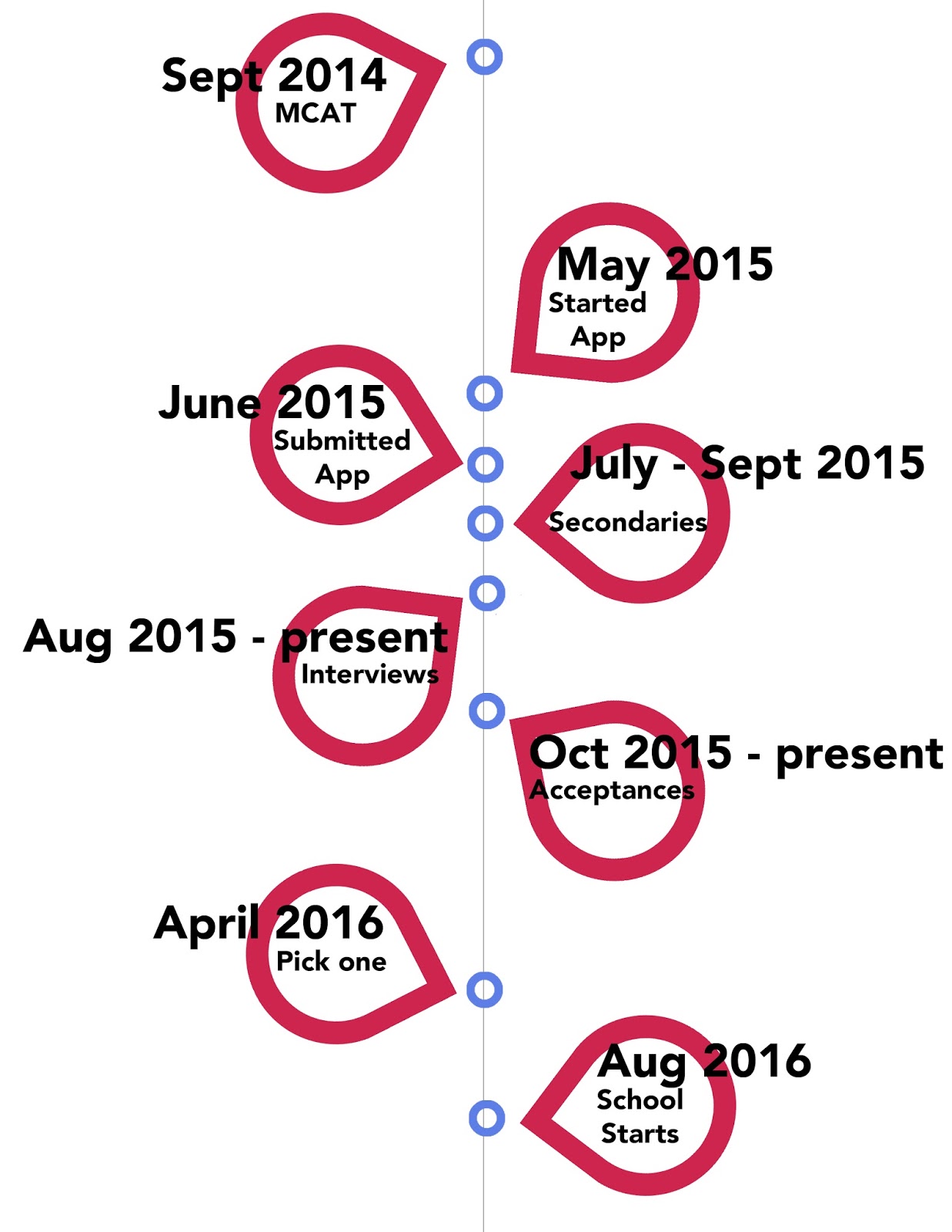
Here’s the timeline I followed:


What makes up the primary application

- Identifying, contact, and biographic information
- Languages - what you speak and how well. If you’re applying to California schools, I recommend learning Spanish.
- Childhood information - try to answer all the questions and stay away from the “do not know” answer
- Disadvantaged Statement - explained below
- Family information and some applicant information (like were you in the military etc.)
- EVERY class and EVERY grade. Yes, EVERY. Including high school AP classes. It’s so tedious
- High school and University information
- GPA
- MCAT and other test scores
- Experiences - explained in the next post
- Personal Statement - Advice on this will be its own post (coming soon!)
- Letters of Recommendation
- Medical Schools


    AAMC Fee Assistance Program (FAP)


    Whether or not you think you'll be approved, I suggest applying for FAP. The worst that could happen is that they'll say no.

    They’ll waive one AMCAS application for up to 15 schools ($664 value) and give you a free MSAR ($25 value, I’ll explain what MSAR is under the “how to pick schools” section). Also, MCAT registration will only be $115 (discounted from $300 per exam) for up to four exams. You’ll receive complimentary MCAT exam prep products ($125 value) and some other MCAT resources.

      Disadvantaged applicant (1325 characters)

      Applicants who consider themselves disadvantaged should fill out the additional short essay. I know it helps with financial aid and scholarships when schools start but I'm not completely sure what each school does with that information. It does not negatively affect your chances of being accepted though. It can only help :)

      I think when writing about your disadvantages, you should end with what you learned. How will these challenges help you become a better physician?

      A few examples:

      • - Lack of opportunity growing up
      • - Having to overcome significant obstacles which may have adversely affected you
      • - Financial problems and low socioeconomic status
      • - Grew up in a low-income community
      • - Underrepresented in medicine
      • - Worked 30+ hours a week during college to support yourself and your family
      • - First generation college student
      • - High school had a low API score when you graduated
      • - Immigrant/English is not your first language
      • - Mental/learning/psychological disability (should be getting treatment for it)


        Primary Application tips to be continued :)

        If you have any questions or comments, please don’t hesitate to leave them in the comment section below. Or you can email me directly using the “contact me” section at the bottom of my blog.